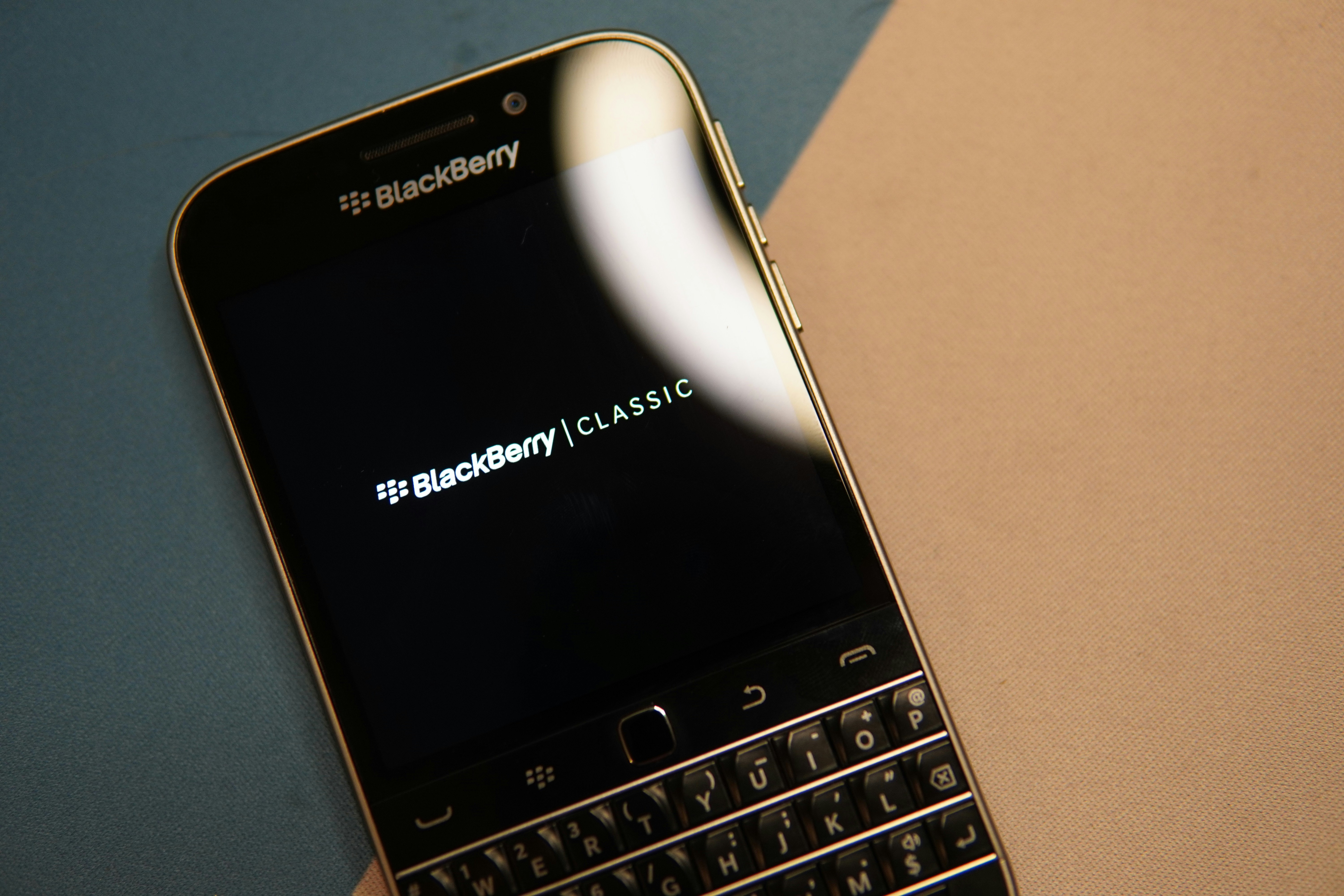
I have been thinking about BlackBerry recently, after watching the 2023 film about its rise and fall. The popular story is that they got complacent, dismissed the iPhone, and got steamrolled. It is a satisfying story because it gives you someone to blame and a lesson to take home. Do not be complacent. Stay paranoid. Listen to weak signals.
I think it is mostly wrong. And the version that is actually true haunts me.
The Story That Does Not Hold Up
In 2008, here is what Mike Lazaridis actually saw. The iPhone had launched the year before to enormous press attention but modest enterprise adoption. It had bad battery life. It could not do proper push email. It had no physical keyboard, which every survey of business users said they wanted. Enterprise IT departments were openly dismissive of it as a toy. RIM’s own sales were still growing rapidly. They would hit peak market share in 2009, two full years after the iPhone launched. The data, the customer feedback, and the financials were all telling Lazaridis his strategy was working.
The signal that touchscreens would win was not legible in 2008. By the time it was legible, around 2010 to 2011, it was already too late. The OS, the developer ecosystem, the supply chain, the internal expertise: all of it would have needed five years to rebuild, and BlackBerry had eighteen months. The window where the right call was both knowable and actionable may not have existed at all.
This is the part of the story that gets obscured by hindsight. The “they should have known” narrative scores the decision against the outcome rather than against the information available at the time. Annie Duke calls this resulting in her book Thinking in Bets, the error of judging the quality of a decision by the quality of its outcome. Most of the “BlackBerry was complacent” narrative is a giant exercise in resulting.
A Better Question
The question that needed to be asked at RIM in 2008 was not “how do we build a better iPhone faster”. That question had no good answer. The real question, and the one most incumbents never ask until it is too late, is the one that needed to be asked five years earlier.
What is our second cash cow?
The implicit assumption in the standard BlackBerry post mortem is that their job was to win the smartphone war. Once you accept that, every option leads back to “compete harder with Apple”, which was never going to work because Apple’s vision was not BlackBerry’s. But the assumption is wrong. The job of a company is not to win every category it happens to be in. The job is to continue existing as a valuable enterprise.
By that standard, BlackBerry’s failure was not the failure to beat Apple. It was the failure to find anything else during the years when they had enormous cash flow, brand recognition, world class engineering talent, deep enterprise relationships, and global distribution. They were sitting on top of more wells than almost any company on earth. They drilled exactly one and kept drinking from it until it ran dry.
And here is the part that makes this most damning. RIM had not always been a one-product company. In their first fifteen years they ran several completely different businesses: LED signs for General Motors assembly lines, an Academy Award winning film synchronisation tool for Hollywood studios, wireless data infrastructure for early enterprise networks, and the two-way pagers that eventually became BlackBerry. They knew how to find new wells. They had built the muscle. Then BlackBerry hit, and they let the muscle die.
This is not a story about being idle. RIM was spending around $1.4 billion a year on R&D by 2010, which made them one of the biggest R&D spenders in Canada. They acquired QNX, a serious industrial operating system used in nuclear power plants and car infotainment. They bought UI specialists. They had research projects running on multiple fronts. The R&D budget was anything but zero.
The problem is where it all went. Almost every pound got funnelled into extending the existing business. BlackBerry OS 6, then OS 7, then the PlayBook OS, then BlackBerry 10. Hardware iterations. Different shapes of the same answer. Even the QNX acquisition, which on paper was the kind of unrelated bet that might have opened a real second door, got immediately absorbed into the smartphone roadmap as the foundation for BB10. What could have been a parallel business became part of the same bet. They were doubling down on the smartphone well at exactly the moment they should have been digging for a new one.
And this is the part I think actually matters. The trap is not really about money or effort. RIM had both. The trap is that exploration was never treated as a discipline distinct from extending the core. It was whatever was left over after the smartphone roadmap got fed, which in practice was almost nothing left over at all. The R&D budget was huge. The exploration imagination was narrow.
Independent, Or It Does Not Count
There is a trap inside the trap here, and it is worth naming because it is the most common way the second cow idea fails in practice.
The trap is building multiple things that look like separate cash cows but are all drinking from the same well. Same customers. Same value proposition. Same failure modes. This is what BlackBerry actually did. OS6, OS7, PlayBook, BB10, the Storm, the Torch. These look like multiple bets, but they were all drawing from a single underlying source: the assumption that enterprise customers would keep buying BlackBerry branded secure mobile devices. When that source ran dry, every bet drawing from it ran dry too. There was no redundancy. There were many cows, but only one well.
A real second cash cow has to be independent in a way that matters. Different customers, or at least different buyers within the same customer. Different value proposition. Different things that have to be true for it to work. The test is simple. If the first cow’s well runs dry tomorrow, does the second one still have water to drink? If the answer is no, you do not have two wells. You have one well, with two cows drinking from it.
QNX is the cleanest illustration of this. The part of QNX that got absorbed into the BlackBerry smartphone roadmap died with the smartphone. The part of QNX that stayed in its own lane, running in cars and industrial systems with its own customers and its own value proposition, is still there, still profitable, still in cars all over the world. Same technology, different fate. The only difference is whether it was correlated with the dying business or not.
This is the version of the second cow idea that I think actually transfers. Diversification is not about doing more things. It is about doing things whose fates are genuinely uncoupled from each other. Otherwise you have just spread your single bet across more line items, which feels safer on the spreadsheet but is structurally the same bet.
What I Wish BlackBerry Had Done
What I keep coming back to is not that BlackBerry should have built a touchscreen phone faster. It is that they should have been making real bets on adjacent things for years before any of it became urgent.
These would have been strategic moves. Visionary bets, even. And RIM was uniquely positioned to make them. With $1.4 billion a year in R&D budget, they could have funded dozens of well resourced internal startups, each one searching for its own well, given each one its own team and its own runway, and let them dig for years without ever threatening the parent business. Every later unicorn that came out of the wells RIM was already sitting on top of had to build its team, its tech, its distribution, and its credibility from scratch. RIM was already on top of the wells in 2004 with all of that in place. They could have outcompeted every one of those companies, started years before any of them existed, with a safety net no startup will ever have.
Think about what they had to work with. Unmatched expertise in secure messaging at scale: this could have been Slack or Signal. World class radio engineers and compression specialists: this could have been half the modern IoT industry. Deep relationships with every major bank, every major government: this could have been the payment gateways. The ingredients for greatness were already in the room, and nobody was being asked to do anything with them except sell more BlackBerry phones.
That, I think, is the actual lesson from BlackBerry. Not that they should have seen the iPhone coming, not that they should have built a better touchscreen faster. They put $1.4 billion a year and the entire future of the company into a single well. When it ran dry, there was nothing else to drink from.