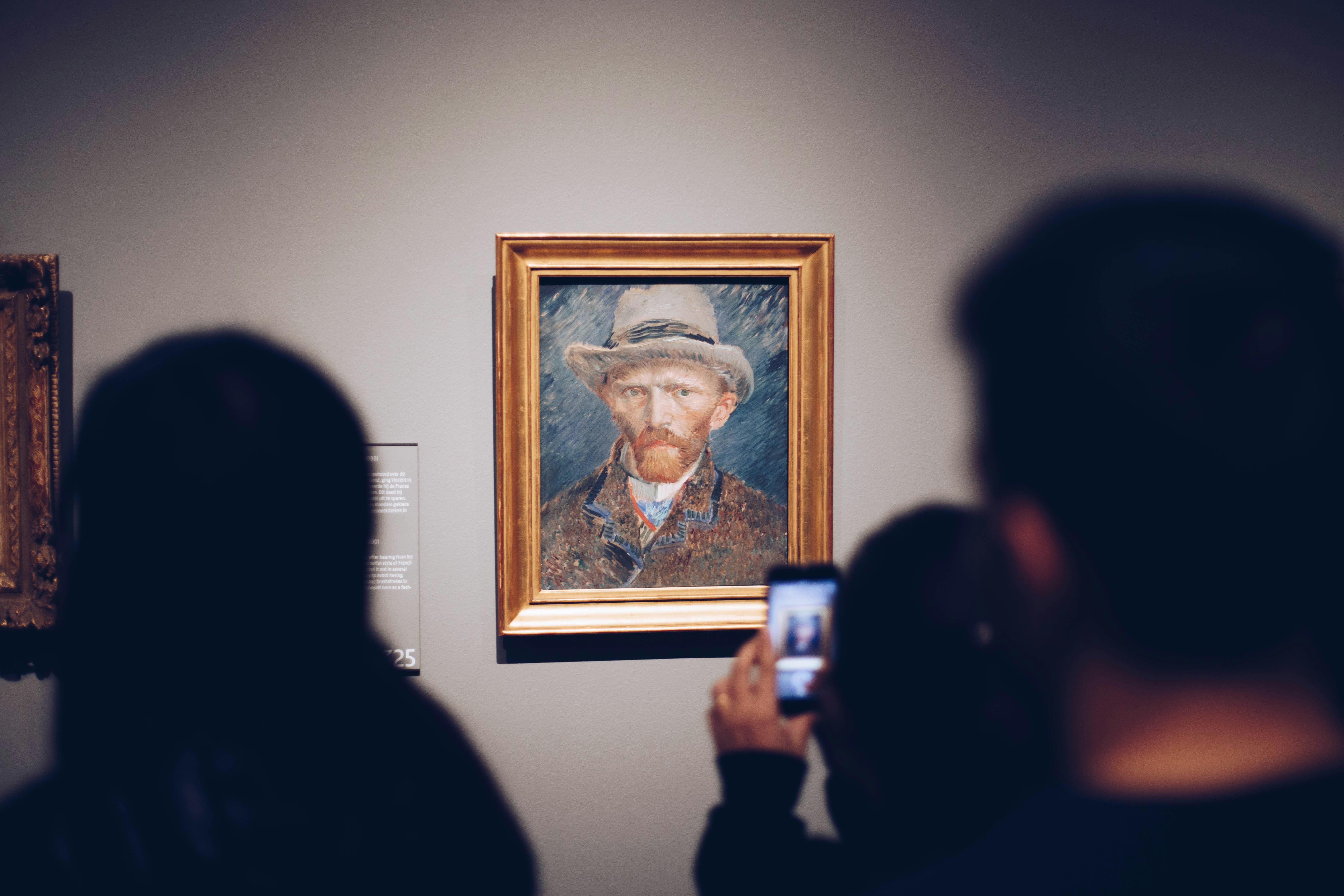
I watched At Eternity’s Gate recently, the Julian Schnabel film about Van Gogh with Willem Dafoe. It is a beautiful piece of work and Dafoe disappears into the role completely.
There is one scene in particular that has stayed with me. A priest visits Vincent in the asylum at Saint-Rémy and asks him, more or less, why he insists on painting things that are ugly. Vincent’s reply, paraphrased gently, is that maybe he is painting for people who have not been born yet. That his work is not for this moment. That it is ahead of its time, and the world will catch up to it eventually, even if he does not live to see it.
It is an extraordinary moment of cinema. He says it without strategy, without any of the framing that line tends to come wrapped in when you hear it elsewhere. It is a tired, devout man reaching for the only frame that makes his situation bearable, and on those terms it is moving in a way that has been hard to shake.
I came out of the film thinking about Vincent, of course. But the more I sat with it afterwards, the more I realised the part of the story I keep returning to is not really about him at all. It is about someone the film barely mentions, and someone the popular version of the story tends to leave almost entirely out of view.
The Person Who Did The Work
Vincent died in 1890. His brother Theo, who had financially supported him for years and championed his work, died six months later. Neither of them got anything out of Vincent’s eventual fame. No money, no recognition, not even the closure of knowing they had been right. They both died inside the version of the story where Vincent was still a failure.
The reason we know Van Gogh’s name today is largely because of Johanna van Gogh-Bonger, Theo’s widow. When Theo died she inherited several hundred paintings that, in 1891, were worth almost nothing. The advice she got from Theo’s colleagues in the Paris art world was that she should leave the paintings behind. They were difficult work, the thinking went, and would be better served by established avant-garde dealers in the city. She ignored this advice entirely. She packed the paintings into crates and took them with her back to the Netherlands.
In Bussum, a village twenty-five kilometres from Amsterdam, she opened a boarding house and took on translation work to support herself and her son. The boarding house and the translation paid the bills. The Vincent project was the thing she did around them, on her own time, funded out of her own pocket, for years, with no guarantee any of it would ever pay her back.
What she did with that time was patient and deliberate in a way I find genuinely impressive. She used Bussum to build her own contacts in the Dutch art world, working her way carefully into the rooms her boarding house guests already lived in. She organised small sales exhibitions to create visibility. She placed paintings strategically with public museums and influential collectors rather than letting them disappear into private hands, because she understood that visibility compounded and private sales did not. And she sold deliberately slowly. Across the whole of 1891 to 1925 she sold around 192 paintings and 55 works on paper, an average of roughly six pieces a year. She was explicitly choosing to build value over decades rather than cash out the inventory.
The slow work compounded. By 1905 she was able to rent the Stedelijk Museum in Amsterdam and stage a retrospective of nearly five hundred of Vincent’s works that brought European critics to the city to see them. In 1914 she published the letters between Vincent and Theo, which gave the world a person to attach to the paintings and made the work legible in a way it had not been before. By the time she died in 1925, Vincent was world famous, and the framing she had quietly built around him was the framing every later reader would inherit.
What strikes me about all of this, looking at it now, is how recognisable the shape of her work is. She spotted a gap the establishment had walked past. She formed a vision of what the work could become, and what would have to be true for the world to agree with her. And then she executed against that vision in small repeated moves, each one building on the last. Take away the centuries and the medium and you have something very close to the shape of every founder I have ever admired.
She did all of this in a world that did not particularly want women running cultural campaigns. She was met with condescension from many of the male artists and critics she encountered, partly because she was a woman, and partly because she was trained neither as an art critic nor as a dealer. None of it was glamorous, and almost none of it looked, from the outside, like the kind of work history eventually credits.
The story we tell is that the world eventually caught up to Vincent. The truer version is that a specific person funded the distribution work out of a Dutch boarding house, defied the professional consensus that her inheritance was best handled by other people, and made deliberate, strategic, incremental moves for more than three decades until the value she had been quietly building became impossible to ignore. If she had been less capable, or less patient, or had simply moved on with her life, it is entirely plausible that Vincent ends up a footnote in a thicker book about the post-impressionists.
I find that genuinely moving, and in a slightly different register than the film moved me. The film is about a painter at the edge of himself. Johanna’s part of the story is about a kind of patient strategic devotion that almost no one tells you about when they tell you about Van Gogh.
And here is the part that I have not been able to stop turning over since I watched the film. Vincent was only right about painting for people not yet born because Johanna spent the next thirty four years going out and finding those people. The line in the priest scene was not a prophecy that fate quietly fulfilled. It was a hope, and the only reason it came true is that someone made it true, in specific rooms, with specific gallery owners and specific collectors, on specific afternoons across decades. Without her, the line stays a beautiful moment in an asylum and nothing more. Vincent was vindicated, but the vindication was not waiting in the future for him. It was built in the present, by someone else, while he was already gone.
Vincent Is Johanna’s Product
I love Vincent’s story and his artwork. Johanna was the storyteller behind both. She edited the letters, wrote the biographical introduction, decided which Vincent the world would meet. The troubled, devout, eloquent painter I have come to know, through this film and through everything else I have ever read or seen about him, is, in a real sense, her edit of him.
Which makes Vincent, technically, Johanna’s product. Her work, her judgement, her decisions about what to include and what to leave out. The film is downstream of her hand. The romantic version of vindication, where genius eventually shines through on its own, is much more comforting and much less true. The real version is Johanna’s story of distribution. Harder, slower, and entirely down to her.
Someone should make a film about her.